No products in the cart.
Return To ShopInnovative Approaches to Financial Education

Innovative Approaches to Financial Education
Financial education is an important part of preparing children for responsible adulthood. It involves teaching children how money works, including how to earn, save, spend, budget, and make responsible financial decisions. Traditionally, financial education has often been taught through classroom lectures, textbooks, and simple explanations from parents or teachers. However, these approaches may not always be sufficient to engage children who learn better through practical and interactive experiences.
Innovative approaches to financial education provide creative ways of helping children understand financial concepts. These approaches make learning more practical, enjoyable, and relevant to children’s everyday experiences. Through games, technology, storytelling, simulations, projects, and other interactive methods, children can develop financial knowledge while also practicing important money management skills.
Meaning of Financial Education
Financial education is the process of providing individuals with the knowledge, skills, attitudes, and behaviors needed to make informed decisions about money. For children, financial education focuses on simple concepts that are appropriate for their age and level of understanding.
Children can learn about saving, spending, budgeting, needs and wants, financial goals, and the importance of making thoughtful choices. The objective is not simply to teach children about money but to help them develop healthy financial habits that can continue into adulthood.
Why Innovative Financial Education Is Important
Children have different learning styles and interests. Some may understand financial concepts better when they see examples, while others may learn more effectively through games, stories, or practical activities. Innovative approaches make financial education more flexible and engaging.
An innovative approach can also connect financial lessons to situations children encounter in everyday life. For example, instead of simply explaining the concept of saving, a teacher could give pupils a hypothetical amount of money and ask them to decide how much to save and how much to spend.
This practical approach allows children to learn by doing rather than simply memorizing information.
Use of Educational Games
Educational games are one of the most effective innovative approaches to teaching financial concepts to children. Games can introduce children to saving, budgeting, spending, earning, and decision-making in an enjoyable way.
For example, a classroom game could give each child a certain amount of imaginary money and present different spending choices. Children would have to decide which items they need, which items they want, and how much money they should keep for future use.
Through such activities, children can learn about financial consequences while participating in an enjoyable learning experience.
Gamification of Financial Education
Gamification involves incorporating elements commonly found in games, such as points, rewards, challenges, levels, and competitions, into educational activities.
Teachers can create financial literacy challenges in which children earn points for completing saving or budgeting exercises. Children could also receive virtual rewards for achieving financial goals.
Gamification can make financial education more exciting and encourage children to participate actively in learning activities.
Storytelling as a Financial Education Tool
Storytelling is another creative approach to financial education. Children often understand complicated ideas more easily when they are presented through stories.
A teacher or parent could tell a story about a child who receives pocket money and has to decide whether to spend it immediately or save it for something more important. The story can then be used to discuss the consequences of different financial decisions.
Stories can make financial lessons memorable because children can relate financial concepts to characters and situations.
Use of Technology
Technology has created new opportunities for financial education. Interactive applications, educational websites, videos, animations, and digital games can introduce children to financial concepts in engaging ways.
For example, children can use age-appropriate budgeting simulations to practice allocating money to different categories. Animated videos can also explain concepts such as saving, budgeting, and distinguishing between needs and wants.
However, technology should be used responsibly and with appropriate adult guidance, particularly when children are learning about digital payments or online financial activities.
Financial Simulations
Financial simulations allow children to practice making financial decisions in a controlled learning environment. A simulation can recreate simple real-life situations without requiring children to use actual money.
For example, pupils could be given a fictional monthly income and asked to allocate it among food, education, transportation, savings, and entertainment. Unexpected events could then be introduced to show how financial decisions can affect their available resources.
This approach helps children understand that money is limited and that financial decisions often involve prioritizing different needs.
Project-Based Financial Learning
Project-based learning allows children to learn financial concepts by completing practical projects. For example, pupils could develop a simple plan for saving money to purchase a desired school item.
They could calculate how much they need, determine how much they can save regularly, and estimate how long it would take to reach their goal.
Such projects can help children develop planning, calculation, problem-solving, and decision-making skills while learning about financial responsibility.
Interactive Classroom Activities
Interactive classroom activities can make financial education more engaging than traditional lectures. Teachers can organize activities such as mock shops, budgeting exercises, role-playing, group discussions, and financial quizzes.
In a mock shop, for instance, children can take turns acting as customers and shopkeepers. They can practice comparing prices, making purchasing decisions, calculating change, and determining whether an item is a need or a want.
These activities provide children with practical experiences that can strengthen their understanding of financial concepts.
Role-Playing Activities
Role-playing allows children to act out different financial situations. One child might act as a customer, while another acts as a shopkeeper. Other students could play roles such as parents, business owners, or financial advisers.
Through these activities, children can explore financial decisions from different perspectives. Role-playing can also develop communication and problem-solving skills.
Financial Literacy Through Art and Creativity
Financial education can also be integrated with creative activities such as drawing, writing, posters, and crafts.
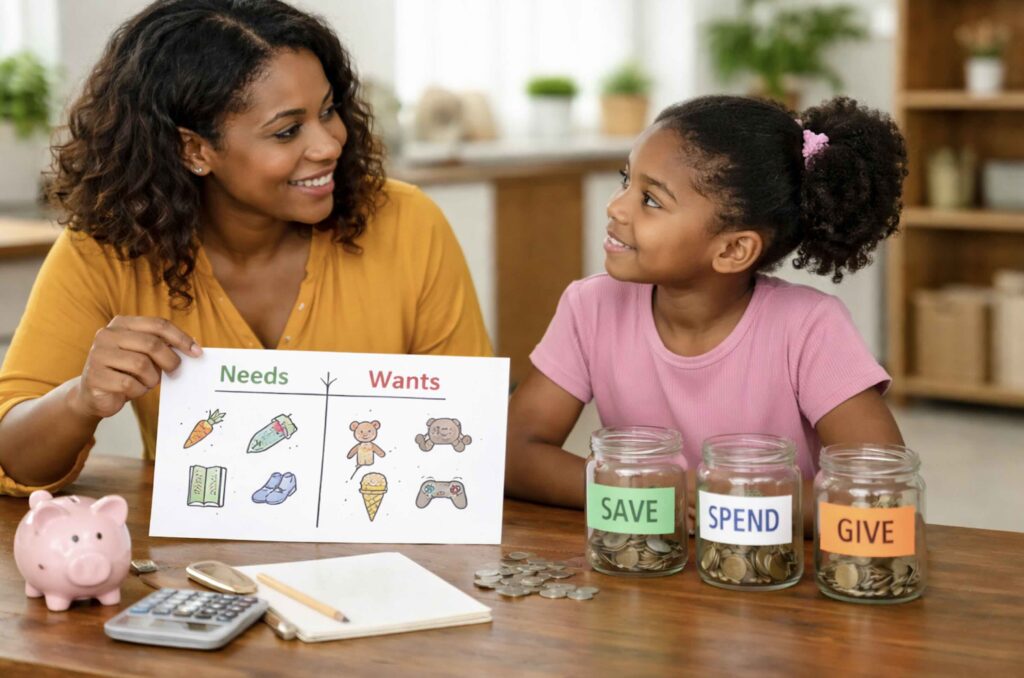
Children could design posters about saving money, create drawings showing the difference between needs and wants, or develop short stories about responsible spending.
Creative activities can make financial education accessible to children who enjoy visual and artistic forms of learning.
Use of Real-Life Examples
Connecting financial education to children’s everyday experiences can improve understanding. Parents and teachers can use familiar examples such as buying school supplies, saving pocket money, comparing prices, or planning a small purchase.
For example, a child who wants to buy a particular item can be encouraged to create a simple savings plan. This transforms an abstract financial concept into a practical learning experience.
Financial Education Through Entrepreneurship Activities
Simple entrepreneurship activities can introduce children to concepts such as earning, pricing, budgeting, profit, and responsible use of resources.
Schools can organize supervised activities where children develop simple products or services as educational projects. The emphasis should be on learning rather than making money.
Through these activities, children can understand that income often involves effort, planning, and responsible decision-making.
The Role of Parents in Innovative Financial Education
Parents have an important role in reinforcing financial lessons at home. They can use everyday activities as opportunities to teach children about money.
Parents can encourage children to save part of their pocket money, help them establish simple financial goals, and discuss the difference between necessary purchases and things they simply want.
Parents can also encourage children to participate in age-appropriate household budgeting discussions without exposing them to information that is inappropriate for their age.
The Role of Schools
Schools provide an organized environment where children can develop financial knowledge and practical skills. Teachers can incorporate innovative financial education into subjects such as Mathematics, Social Studies, Civic Education, and Economics where appropriate.
Schools can also organize financial literacy clubs, competitions, games, exhibitions, and project-based activities to encourage children’s interest in money management.
Benefits of Innovative Financial Education
Innovative approaches to financial education offer several benefits to children. They can:
- Make financial concepts easier to understand.
- Increase children’s interest and participation.
- Encourage responsible spending and saving.
- Improve financial decision-making skills.
- Develop problem-solving and critical-thinking abilities.
- Help children connect classroom learning with everyday life.
- Encourage goal setting and planning.
- Make financial lessons more memorable.
- Build confidence in handling simple financial decisions.
Challenges of Innovative Financial Education
Despite its benefits, innovative financial education may face some challenges. Some schools may lack adequate teaching materials, technology, or trained teachers. Financial education may also receive limited attention when compared with other academic subjects.
In addition, not all children have the same access to digital devices or internet services. Therefore, relying entirely on technology could exclude some learners.
To address these challenges, schools can combine digital approaches with low-cost methods such as storytelling, role-playing, games, group activities, and practical classroom exercises.
Innovative Financial Education in the Nigerian Context
In Nigeria, financial education can be particularly useful because children are growing up in an increasingly cashless and technology-driven financial environment. Children encounter different forms of financial transactions and need age-appropriate knowledge to understand basic money management.
Schools and families can introduce financial education using locally relevant examples. Activities can involve familiar situations such as managing pocket money, saving for school materials, comparing prices in local markets, and understanding the difference between needs and wants.
The use of simple, affordable teaching methods can make financial education accessible to children in both urban and rural communities.
Final Thoughts
Innovative approaches to financial education provide effective ways of teaching children the knowledge and skills they need to manage money responsibly. Methods such as educational games, storytelling, technology, simulations, role-playing, project-based learning, and practical activities can make financial education more engaging and meaningful.
Financial literacy should not be viewed as something children only need to learn when they become adults. Introducing appropriate financial concepts at an early age can help children develop positive attitudes toward money, responsible spending habits, saving practices, and sound decision-making skills.
By combining the efforts of parents, teachers, schools, and communities, financial education can become a practical and enjoyable part of children’s development.